
← Back to the Desk

On the Desk

The Desk archive

Every book that has passed across the Desk, with the full note: what it is, why it matters, the reflection it prompted and the question it leaves open.

3 books
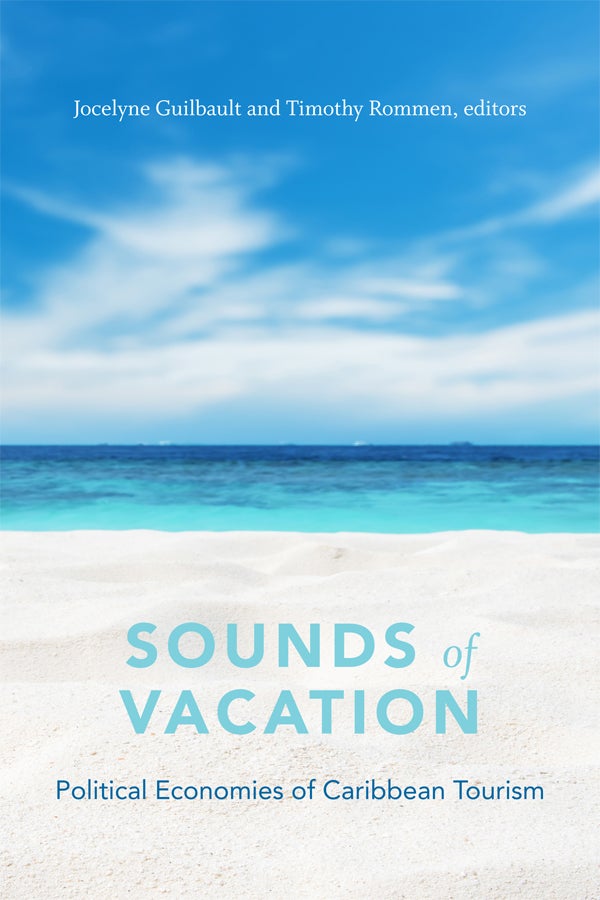
Sounds of Vacation: Political Economies of Caribbean Tourism book cover

On the desk since 15 October 2026

Sounds of Vacation: Political Economies of Caribbean Tourism

Edited by Jocelyne Guilbault and Timothy Rommen, Duke University Press, 2019.

Framework: Generative Development

Overview

This collection examines how music and sound are turned into commodities at Caribbean holiday destinations, and ties that process to the political economy of tourism, to hospitality work, and to the legacies of slavery and colonialism.

Drawing on interviews with resort managers, musicians and hospitality workers across four islands, the book asks who is paid, which sounds are quietened, and how Caribbean life is tuned to the visitor's idea of paradise.

Why it matters

Tourism is often presented as the Caribbean's way out of the plantation economy. This book suggests it may also be one of the ways the plantation economy reproduces itself: in who owns the resort, who performs, who serves, and how Caribbean culture is packaged for someone else's enjoyment.

It asks the questions I return to in every case: whose interests are served, what it costs and to whom, and how the arrangement replicates itself.

A question I am still thinking about

If the music stopped being played for visitors, what would the Caribbean play for itself?

Sylvia Wynter: On being Human as Praxis

On the desk since 9 October 2026

Sylvia Wynter: On Being Human as Praxis

Edited by Katherine McKittrick, Duke University Press, 2015.

Framework: Knowledge, Method & Power

Overview

This collection, edited by Katherine McKittrick, brings together essays by scholars working with the thought of Sylvia Wynter, the Jamaican writer and philosopher, alongside an extended conversation between Wynter and McKittrick.

Together they trace Wynter's central argument: that the dominant Western idea of the human is one particular description of humanity that has come to be presented as universal.

Why it matters

Wynter's work continues to challenge some of the deepest assumptions underpinning development, governance and knowledge production. Rather than treating existing understandings of the human as universal, she asks how they came to be constructed, whose experiences they privilege, and what alternative futures become possible when those assumptions are made visible.

This perspective runs through much of my work, including the essay What Naomi Osaka Made Visible, where Wynter's critique of the universal helps explain how particular cultural norms come to appear neutral, natural and therefore beyond question.

Reflection

As I continue developing Generative Fit, Wynter reminds me that effective development is not only about designing better policies. It also requires questioning the inherited ideas about humanity, progress and legitimacy on which those policies are built.

Her work reinforces a central proposition of my research: that the frameworks we use to understand the world shape the futures we are able to imagine.

A question I am still thinking about

Which of the things we call universal were simply someone else's ideas and habits?

How Britain Underdeveloped the Caribbean: A Reparation Response book cover

On the desk since 8 October 2026

How Britain Underdeveloped the Caribbean: A Reparation Response to Europe's Legacy of Plunder and Poverty

By Hilary McD Beckles, The University of the West Indies Press, 2015.

Framework: Generative Development

Overview

Beckles rejects the idea that Caribbean underdevelopment is the product of internal weakness or policy failure. Instead, he demonstrates how the region's economic structures were deliberately designed to extract wealth, and how many of those inequalities persisted long after formal independence.

His work reframes development as a historical and political question, rather than simply an economic one.

Why it matters

Beyond its historical account, Beckles raises an enduring policy question: what does development look like when the institutions, economies and governance structures inherited from colonialism continue to shape the present? His work reminds us that development cannot be understood apart from these historical legacies.

Beckles reinforces the importance of beginning with those realities, rather than assuming development starts from a blank slate.

A question I am still thinking about

If Britain grew rich from the Caribbean, why is the Caribbean the one asked to reform?

Read along

New entries on the Desk, sent to you.

Each new book on the Desk is sent with the newsletter, together with the essays and episodes it shapes. You can leave at any time.